Issue 02 · Doha · Landmark · Doha Corniche
National Museum of Qatar
Interlocking discs the colour of desert sand, closed around a restored palace.
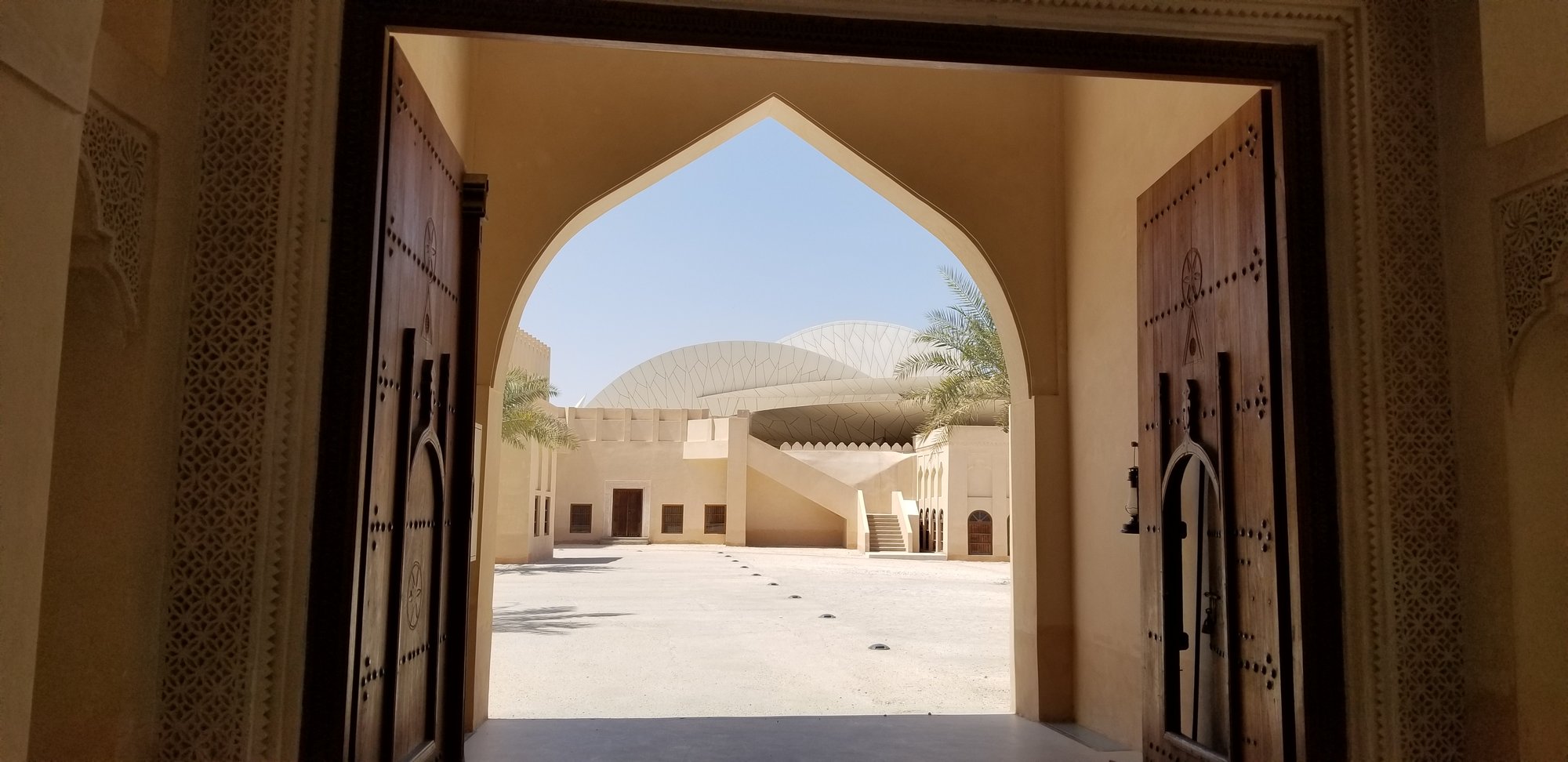
Jean Nouvel’s National Museum of Qatar takes its form from the desert rose — the crystalline clusters, known locally as kuhoof or al-kuhoof, that form in sand under wind and salt water. The architect has written that he needed a symbol able to hold Qatar’s long rapport with the desert and the “spirit of modernity and daring” that followed. The building was constructed around the restored palace of Sheikh Abdullah bin Jassim Al Thani, once the family home and the seat of government. It was inaugurated on 27 March 2019 and opened to the public the following day.
The skin is a high-performance glass-fibre-reinforced concrete, sand-coloured inside and out, segmented across a field of inward-curving discs — some 539 of them, in 30 sizes, according to published engineering accounts of the project. A secondary structure carries tens of thousands of Fibrex panels, fixed with stainless-steel embeds. When the sun is low in the east or west, the discs throw long shadows and keep the galleries cooler. Inside, the same intersecting planes continue, so that the route through the museum is a sequence of rooms that could only have been made this way, ending at the old palace.